Industrial Tool and MRO Inventory Management: Tools, Gauges, CNC Consumables, Spare Parts and PPE
A shared wrench should come back after the job. A box of cutting inserts is usually managed through quantity-based issuing. A gauge may be physically present but unavailable because it requires inspection or calibration. These are different inventory problems, even when all the items belong to the same factory.
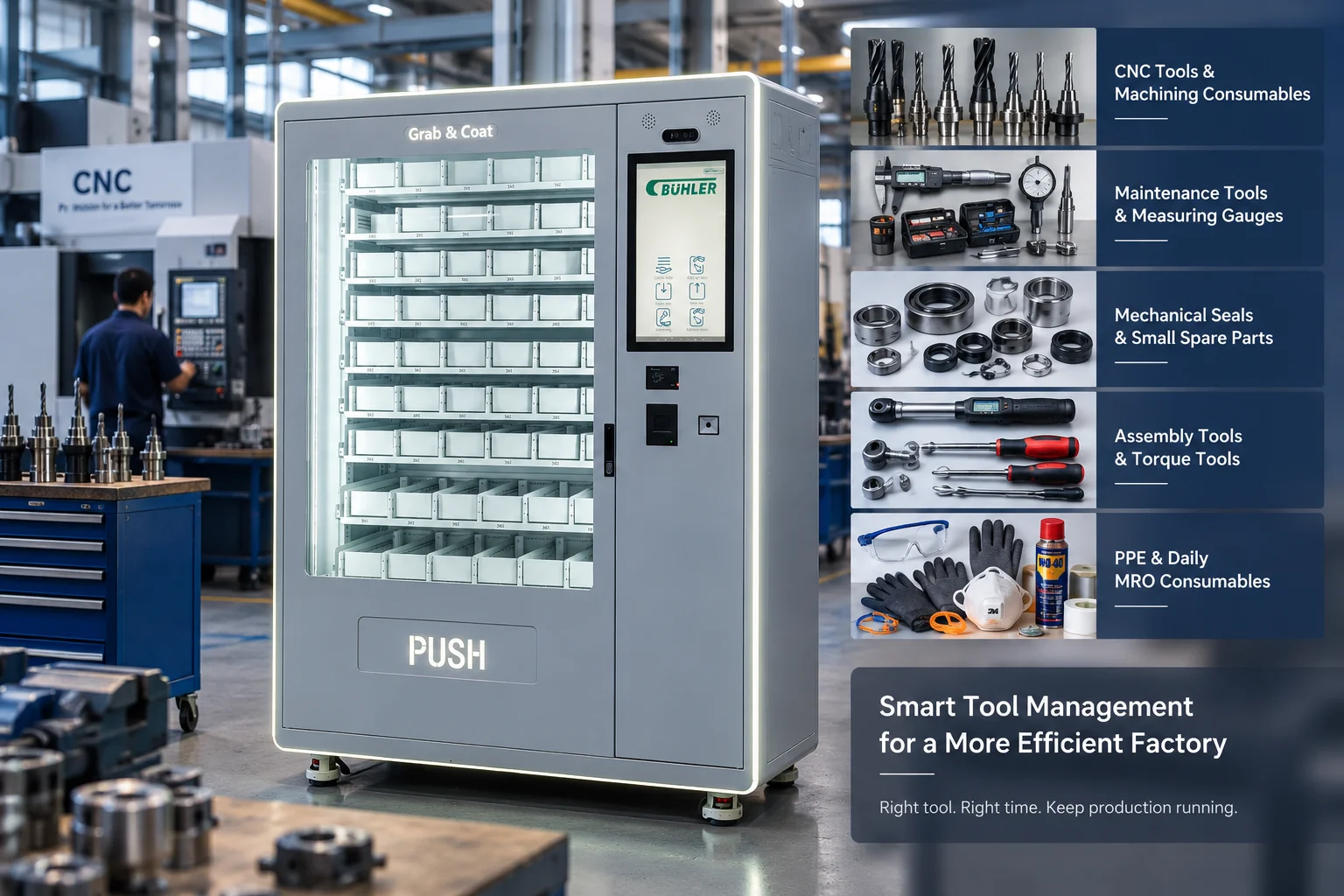
Effective industrial tool and MRO inventory management begins by separating reusable tools from consumables and replacement parts, then matching each group to an appropriate storage and access method. MRO means maintenance, repair and operations; it is not a reason to apply one dispensing rule to every material.
The common objective is straightforward: an authorized issue, a traceable destination and a reliable view of what can be used next. Cabinet capacity matters, but the workflow determines whether that capacity supports production.
1. Maintenance tools and gauges: track the borrower and readiness for use
Wrenches, power tools, inspection fixtures, calipers and specialist measuring equipment may need individual asset IDs. Decide whether each item is tracked separately or whether a complete kit is checked out as one unit. A toolbox being returned is not, by itself, proof that every tool is inside it.
For measuring tools requiring assigned protective positions, consider a smart drawer tool cabinet for gauges and precision tools. Larger equipment and toolboxes may be better suited to individual locker compartments. Match the layout to the actual tool, its case and the handling space needed for reliable return.
Where calibration due dates, certificate links or issue lockouts are required, list them explicitly in the project scope. Maintenance tool tracking records custody and availability; it does not replace calibration, inspection or a decision that a measuring instrument is fit for use.
2. CNC tools and machining consumables: separate issuing, recovery and reuse
End mills, drills, taps, carbide inserts and machining consumables should be organized by approved specification, issue unit, stock quantity and destination. Define whether the operator receives a single tool, an insert pack or another standard unit before configuring CNC tool inventory management.
Compare the CNC tooling and dispensing formats in Qtech’s industrial tool cabinet product range against the workshop’s packaging and issue frequency. Controlled access, transaction recording, return tracking and low-stock rules should be confirmed for the selected model and software workflow.
Toolholders, clamping components and tools suitable for regrinding need a different lifecycle from single-use consumables. Separate available, checked-out, awaiting-regrind and withdrawn states where relevant. Receiving a worn cutter for recovery should not automatically restore it to the available-new-tool count.
Likewise, reporting how many tools were issued to a machine or work order does not measure their actual cutting life. Treat issue data as one source of operational information, not a substitute for machining-process data.
3. Mechanical seals and small spare parts: identify the exact part first
Mechanical seals, bearings, O-rings and small maintenance spares should be identified by part number, specification and applicable equipment. Record approved alternatives where they exist. Visually similar parts should not share a vague label that forces the technician to decide from appearance alone.
Preserve protective packaging and identification information where required. Storage conditions, shelf-life limits and handling precautions should follow the supplier’s instructions for the specific part. A standard cabinet must not be assumed to provide special moisture control, temperature control or material-preservation conditions.
For critical spares, set replenishment rules around equipment needs, actual usage and purchasing lead time. Configurable compartments can help accommodate mixed package sizes, but the selected layout still needs to be checked with the real stock. Mechanical seal inventory management is most useful when the record points to the correct, usable replacement part.
4. Assembly and torque tools: connect tool identity to the operation
For shared assembly tools, define the responsible team, permitted workstation and return position. Torque wrenches and other controlled tools may require an individual ID and a clearly defined usable or on-hold status. The process and quality teams should determine the required range, setting and calibration procedure.
An industrial tool management system can support access and handover records, but it does not replace torque-setting verification or the operator’s work instructions. Where the project needs to restrict a specific tool to a specific operation, agree on the data mapping and approval logic rather than assuming that a cabinet login provides this control.
5. PPE and everyday MRO supplies: maintain access while recording usage
Gloves, safety glasses, earplugs, wipes, batteries and similar supplies can be managed through quantity-based issuing and replenishment. Record usage by employee or department where appropriate, and set stock alerts using the actual demand pattern rather than a single rule for every item.
A PPE vending machine or another suitable dispensing cabinet can form part of a broader industrial inventory management solution. Match the mechanism to the package size and the required issue quantity. Retain a practical replacement and emergency-access process so issuing limits do not prevent employees from obtaining necessary protective equipment.
Choose the cabinet structure after defining the workflow
Drawer storage and individual compartments can suit precision instruments and small reusable tools. Locker compartments can accommodate larger tools, cases and mixed-size materials. Automated storage may be appropriate for reusable items with shapes and packaging suitable for mechanical handling.
For tagged assets requiring individual identification, assess the RFID options within Qtech’s configurable smart cabinet range. For batches of small parts with relatively consistent unit weights, a weighing-based approach may be worth evaluating. Test the effect of weight variation, packaging and mixed items before accepting the counting method; weighing does not inherently identify every part number.
Use consistent records without forcing identical rules
For reusable tools, plan to record asset ID, borrower, task, checkout time, return time and condition. For consumables, record item code, specification, issue unit, quantity and replenishment information. Add equipment compatibility for critical spares and inspection or calibration status where the process requires it.
Start with one busy issue area. Reconcile physical stock with the records, test the workflow across shifts and make sure returns are handled consistently. Evaluate average retrieval time, overdue tools, inventory discrepancies and stockout events against a real baseline rather than promising a savings percentage before the project begins.
Start with a material list, not just a capacity question
Ready to improve your toolroom or point-of-use inventory? Explore Qtech industrial tool and MRO inventory solutions and share photographs, dimensions, user numbers, checkout-versus-consumption rules and the records your team needs. Classify the materials first, then select the combination of drawers, lockers, automated storage and identification options that fits the work.
Frequently Asked Questions
Can maintenance tools and PPE use the same management platform?
A project can be planned around shared users and reporting, while keeping reusable-tool checkout and consumable-issue rules separate. Confirm the software scope and select cabinet structures suited to the different materials.
Do all smart cabinets automatically put returned tools back in place?
No. Drawer cabinets generally rely on employees to place items in the correct compartments. RFID primarily addresses identification and recording. An automated micro warehouse cabinet may use an internal mechanism for put-away. Confirm the function for the specific model.
Is a cabinet still useful when the factory has ERP or MES software?
It depends on the gap in the current process. A cabinet can support controlled access and transaction capture where materials are physically issued and returned. Any connection to existing systems needs an agreed scope, field mapping and exception-handling process; integration should not be assumed to be automatic.